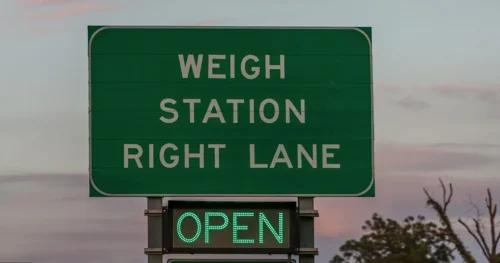
So you are driving down the interstate enjoying the warm weather and empty roads when you see the sign for the weigh station up ahead is flashing telling you to pull in and now you are wondering if you are guilty of any DOT violations. In this article on Truck Driver CDL101 we are going to take a look at the most common DOT violations found at weigh stations. I am going to break this particle article down to two sections: Equipment and Driver Common DOT Violations
What Are The Most Common DOT Violations
1. Lights
2. Brakes
3. Tires
4. Log Books
5. CDL Issues
6. Language Issues
7. DOT Medical Issues
8. Drug and Alcohol Violations
Common DOT Violations Regarding Equipment
A) Lights – The most common violation that truck drivers get nailed for at the weigh station are issues involving lights. Whether it is the headlights or brake lights on the actual truck or lights involving the trailer such as marker lights or once again brake lights. Since it is pretty obvious when a light is out to the DOT officer it makes sense this is the most common DOT violation
B) Brakes – The second most common violation found at weigh stations deal with brakes. Whether the brakes are out of adjustment or just plainly falling apart. It also can be an audible air leak or an ABS issue such as the light being on
C) Tires – Another common DOT violation has to deal with tires. The tires may be in poor repair such as cracks or other issues. What most DOT officers are looking for is tread depth on the tire, steer tires must have 4/32 inch of tread depth; other tires must have 2/32 inch
Common DOT Violations Regarding Driver
A) Log Books – If the DOT officer decides to look at your log books/ELD than hopefully everything is right where it is suppose to be. The most common violations are exceeding your driving limits, falsifying your logs and missing information. Basically any issues with your Hours Of Service falls in this category
B) Issues With Their CDL – Now this could be that the Driver does not have a CDL and may never had a CDL but the most common violation in this area are issues with the CDL. It could be that the CDL has expired or is suspended or the driver is not qualified to be pulling the given equipment. Basically a class B driver pulling class A equipment
C) Language Issues – A drivers inability to speak or read English is a growing DOT violation over the last few years. If the driver can not speak English or read English to an acceptable level their CDL may be taken from them. If the driver is unable to communicate with the DOT officer in English there is going to be a problem
D) DOT Medical Issues – The most common violation for this category is an expired medical certificate
E) Drug And Alcohol Violations – Unfortunately there are a small percentage of CDL drivers who decide to drink alcohol or use drugs while driving. If the DOT officer decides the person is impaired they are immediately taken out of service and the local police are called. Refusing to take a drug/alcohol test is a major DOT violation.
Most companies safety teams have bigger issues with a DOT violation that revolves around the driver than around equipment7
Common DOT Violations According To The FMCSA
Parts & Accessories Violations (vehicle violations) Relevant Code
Not having required operable lamps 393.9
Clamp/roto-chamber type brake(s) out of adjustment 393.47(e)
No/discharged/unsecured fire extinguisher 393.95(a)
Inoperative turn signal 393.9TS
Tire-flat and/or audible air leak 393.75(a)
No/defective lighting devices/reflective devices 393.11
CMV manufactured after 10/19/94 has an automatic airbrake adjustment system
that fails to compensate for wear 393.53(b)
Windshield wipers inoperative/defective 393.78
Tire tread depth less than 2/32 of an inch 393.75(c)
No/insufficient warning devices 393.95(f)
Vehicle Maintenance Violations (vehicle violations) Relevant Code
Operating a CMV without proof of a periodic inspection 396.17(c)
Parts or accessories in disrepair 396.3(a)(1)
Oil or grease leak 396.5(b)
Brakes out of service: the number of defective brakes is equal to or
greater than 20 percent of the service brakes on the vehicle or
combination. Breaks General. Brake system pressure loss.
396.3(a)(1)
Failure to correct defects noted on previous inspection report 396.9(d)(2)
Hubs – oil and/or grease leaking from hub – outer wheel 396.5(b)
Tires (general) 396.3(a)(1)
A liquid fuel system with a dripping leak at any point. 396.3(a)(1)
Hubs―wheel seal leaking 396.5(b)
Unsafe operations forbidden 396.7
Universal joint with loose, broken, or missing component, or bearing
strap 396.3(a)(1)
Driver Qualification Violations (driver violations) Relevant Code
No medical certificate in driver’s possession, and operating a property-carrying
vehicle without possessing a valid medical certificate 391.41
Expired medical examiner’s certificate 391.45
Driver does not have a valid operator’s license for the CMV being operated 391.11
Driver cannot read or speak the English language sufficiently to respond to official
inquiries 391.11
Driver lacking physical qualification(s) 391.11
2
Driver operating a CMV without proper endorsements or in violation of restrictions 391.11
Driving a CMV while disqualified—suspended for safety-related or unknown reason
and in the State of driver’s license issuance 391.15
Driving a CMV while disqualified—suspended for non-safety-related reason and in
the State of driver’s license issuance 391.15
Driving a CMV in Interstate Commerce and driver is less than 21 years of age 391.11
Driving a CMV while disqualified—suspended for a safety-related or unknown reason
and outside the driver’s license State of issuance 391.15
Driver Training Violations (driver violations) Relevant Code
Operating a CMV without a CDL 383.23
Driving a CMV while CDL is suspended for a safety-related or unknown reason and
in state of driver’s license issuance. 383.51
Failing to submit medical certification documentation as required 383.71
Operating a CMV with an improper CDL group 383.91
Driving a CMV while CDL is suspended for a non-safety-related reason and in the
state of driver’s license issuance 383.51
Driving a CMV while CDL is suspended for safety-related or unknown reason and
outside the state of driver’s license issuance 383.51
Operating on learner permit without a CDL holder 383.25
Driving a CMV while CDL is suspended for a non-safety-related reason and outside
the state of driver’s license issuance. 383.51
Operating a commercial motor vehicle without the required knowledge of general
areas 383.111
No hazardous materials endorsement on CDL 383.93
Driving Violation (driver violations) Relevant Code
Moving violations, such as:
- Speeding
- Following too closely
- Improper lane changes
- Reckless driving
- Improper turns
- Failure to yield to right of way
- Railroad grade crossing violations
- Failure to obey a traffic control device
392.2
Failing to use seat belt while operating CMV 392.16
Using a hand-held mobile telephone while operating a CMV 392.82
Driver on duty and in possession of a narcotic drug / amphetamine 392.4(a)
Failing to use hazard warning flashers 392.22(b)
Operating a property-carrying commercial motor vehicle while all other
occupants are not properly restrained. 392.16(b)
Using or equipping a CMV with radar detector 392.71(a)
3
Driver having possession of alcohol while on duty, or operating, or in
physical control of a CMV 392.5(a)(3)
Unauthorized passenger on board CMV 392.60
Driving a commercial motor vehicle while texting 392.80(a)
Hours of Service Violations (driver violations) Relevant Code
False RODS 395.8(e)
ELD – No record of duty status (ELD Required) 395.8(a)
Form and manner issues, such as: log does not include miles traveled / log does
not include locations 395.8
ELD cannot transfer ELD records electronically 395.24(d)
Driver failed to maintain supply of blank drivers records of duty status graph-grids 395.22(h)
Drivers record of duty status not current 395.8(f)
Driver failed to manually add shipping document number 395.24(c)
Driver failing to maintain ELD instruction sheet 395.22(h)
Portable ELD not mounted in a fixed position and visible to driver 395.22(g)
Driver failed to certify the accuracy of the information gathered by the ELD 395.30(b)
No record of duty status when one is required (ELD not required) 395.8
Driver failing to maintain ELD user manual 395.22
Driving beyond 14-hour duty period (property carrying vehicle) 395.3
Driving beyond 11-hour driving limit (property carrying vehicle) 395.3
Controlled Substances & Alcohol Violations Relevant Code
Failing to Implement a drug/alcohol testing program 382.115(a)
Using a driver before receiving a pre-employment drug test result 382.301(a)
Failing to conduct post-accident alcohol or drug test 382.303
Failing to do random drug tests at applicable annual rate 382.305(b)(2)
Driver performing safety-sensitive function without follow-up 382.503
Using a driver who refused to take drug/alcohol test 382.211
Using a driver with a .04 alcohol level 382.201
Failing to implement a random controlled substance or alcohol testing program 382.305
Failing to do random alcohol tests at the applicable annual rate 382.305(b)(1)
Using a driver who has tested positive for a drug 382.215
Hazardous Materials Violations
Package not secure in vehicle
Relevant Code
No copy of USDOT hazmat registration number 107.620(b)
177.834(a)
No shipping papers, carrier
Shipping paper accessibility
177.817(a)
177.817(e)
No required placards or markings when required
Vehicle not placarded as required 172.504(a)
177.823(a)
Prohibited placarding
Placard damaged, deteriorated, or obscured
172.502(a)(1)
172.516(c)(6)
Maintenance/accessibility of emergency response information
Offer or transport without emergency response information
172.602(c)(1)
172.600(c)
Common DOT Violations Regarding Company
Now if you are pulled into an inspection bay or pulled over to the side of the road so the officer can search for DOT violations it may be who you work for. All trucking companies have a CSA safety score and the lower the score is will increase the chances of being pulled over for an inspection or asked to park in a inspection bay.
When you pass a weigh station take a look at the trucks and trailers that are parked in the inspection bays and chances are you will begin to see the same companies over and over again. This is also useful when it comes to seeking employment as it will tell you how well some trucking companies maintain their equipment
Common DOT Violations Conclusion
In order to be considered a professional driver you must take DOT violations seriously and do your best to avoid them. If a driver at a truck company receives a number of DOT violations than chances are his/her employment is in jeopardy.
The majority of DOT violations are easy to avoid through proper training and a proper pretrip. If you find a problem with your equipment before leaving the terminal or shipper/receiver you must take care of it before hitting the road