When it comes to being a new CDL driver one of the areas that most truck drivers struggle with is Hours Of Service (HOS) and how it breaks down. In this article on Truck Driver CDL101 we are going to look at how the Federal Motor Carrier Safety Administration (FMCSA) and a simple breakdown of each area. Thankfully with the introduction of Electronic Logging Devices (ELD) it is much easier to keep track of your Hours of Service
Hours Of Service: 14 Hour Limit
FMCSA – May not drive beyond the 14th consecutive hour after coming on duty, following 10 consecutive hours off duty. Off-duty time does not extend the 14-hour period.
Basically this means your entire day can not last longer than fourteen hours. So if you start your day at 7:00am then no matter what you need to be shut down by 9:00pm. The only real exceptions are the adverse weather conditions and the sleeper berth provision which we will cover later in this article.
Hours Of Service: 11 Hour Rule
FMCSA – May drive a maximum of 11 hours after 10 consecutive hours off duty.
Basically this means that you can not have more than eleven hours driving on a given day. The only way to reset the eleven hour rule is by spending ten hours consecutive in the sleeper berth. In Canada you are allowed to drive for twelve hours per day.
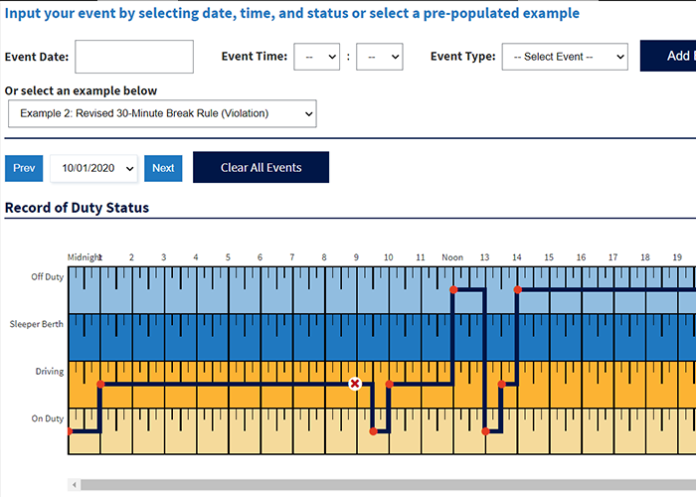
Hours Of Service: 30 Minute Break
FMCSA – Drivers must take a 30-minute break when they have driven for a period of 8 cumulative hours without at least a 30-minute interruption. The break may be satisfied by any non-driving period of 30 consecutive minutes (i.e., on-duty not driving, off-duty, sleeper berth, or any combination of these taken consecutively).
Basically you must take a thirty minute break for every eight hours of work. It is essential that you put yourself off duty and do not go back on duty until your thirty minute break is completed. If you go back on at twenty nine minutes then your 30 minute break requirement is not met.
It should be noted the 30 minute break does not exist in Canada. However if you are a Canadian driver crossing into the US and are staying longer than eight hours you need to take the 30 minute break
Hours Of Service: 60/70 Hour Limit
FMCSA – May not drive after 60/70 hours on duty in 7/8 consecutive days. A driver may restart a 7/8 consecutive day period after taking 34 or more consecutive hours off duty.
This is when the HOS starts to get a bit confusing. This area deals with the number of hours you are allowed to work in a given time frame. Whether it is 60 hours over a seven day period or 70 hours over a eight day period.
On the seventh day of the sixty hour week you will get back hours from the first day of the week and the same for the seventy hour week where you will get the hours back from the first day. This is known as running on recaps. The only way to reset your hours is to take a thirty four hour break.
Some truckers will attempt to work the same hours each day which allows them to run off of recaps for weeks at a time.
It should be noted here that in Canada you must take twenty four hours off every fourteen days. Also in order to reset your hours in Canada you need to take thirty six hours off consecutively
Hours Of Service: Sleeper Berth Provision
FMCSA – Drivers may split their required 10-hour off-duty period, as long as one off-duty period (whether in or out of the sleeper berth) is at least 2 hours long and the other involves at least 7 consecutive hours spent in the sleeper berth. All sleeper berth pairings MUST add up to at least 10 hours. When used together, neither time period counts against the maximum 14- hour driving window.
To be honest I have never used the sleeper berth provision as the company I worked with while driving OTR did not allow it. This is actually pretty common. Here is how Schneider describes it: Sleeper berth rules allow commercial drivers to split their mandatory 10-hour off-duty break into two periods (e.g., 7/3 or 8/2 hours) to increase flexibility. To qualify, one break must be at least 7 consecutive hours in the berth, and the other at least 2 consecutive hours in the berth or off-duty. Together, they must total 10+ hours and pause the 14-hour clock
Hours Of Service: Adverse Driving Conditions
FMCSA – Drivers are allowed to extend the 11-hour maximum driving limit and 14-hour driving window by up to 2 hours when adverse driving conditions are encountered.
This is the one area that drivers tend to abuse. Whether it is trying to get home or find a place to park for the night they will use this area to extend their work day. That being said if your logs are inspected by the DOT you are going to have to explain why you used it and they will compare it to paast weather conditions
When used properly the adverse driving conditions will allow you an extra two hours if you run into bad weather or a highway shutdown
Hours Of Service: Conclusion
The Hours Of Service can be a bit confusing when you start off and the area most new drivers will struggle with comes to running off of recaps. Thankfully with ELDs it is a lot easier to figure out how many hours you will gain at the end of the week and how many hours you will have going forward.
Make sure that you are carrying a paper log in your truck for those times when the ELD decides it no longer wants to cooperate.
When it comes to trip planning it is essential to figure out whether or not you will have enough hours in order to get to the shipper or receiver or back to your terminal. The last thing your dispatcher wants to hear is that your do not have enough hours in order to complete your delivery so in conjunction with your trip planning must be your hours of service which will tell you how much hours are available.
I should note here that Hours of Service violations are serious and the DOT are constantly looking to ensure that the driver is obeying the HOS and is legal. If your HOS is showing a bunch of red than the DOT officer can place you out of service and force you to take a 34 hour reset before you are allowed to move again. A 34 hour reset at a weigh station is a recipe for boredom.